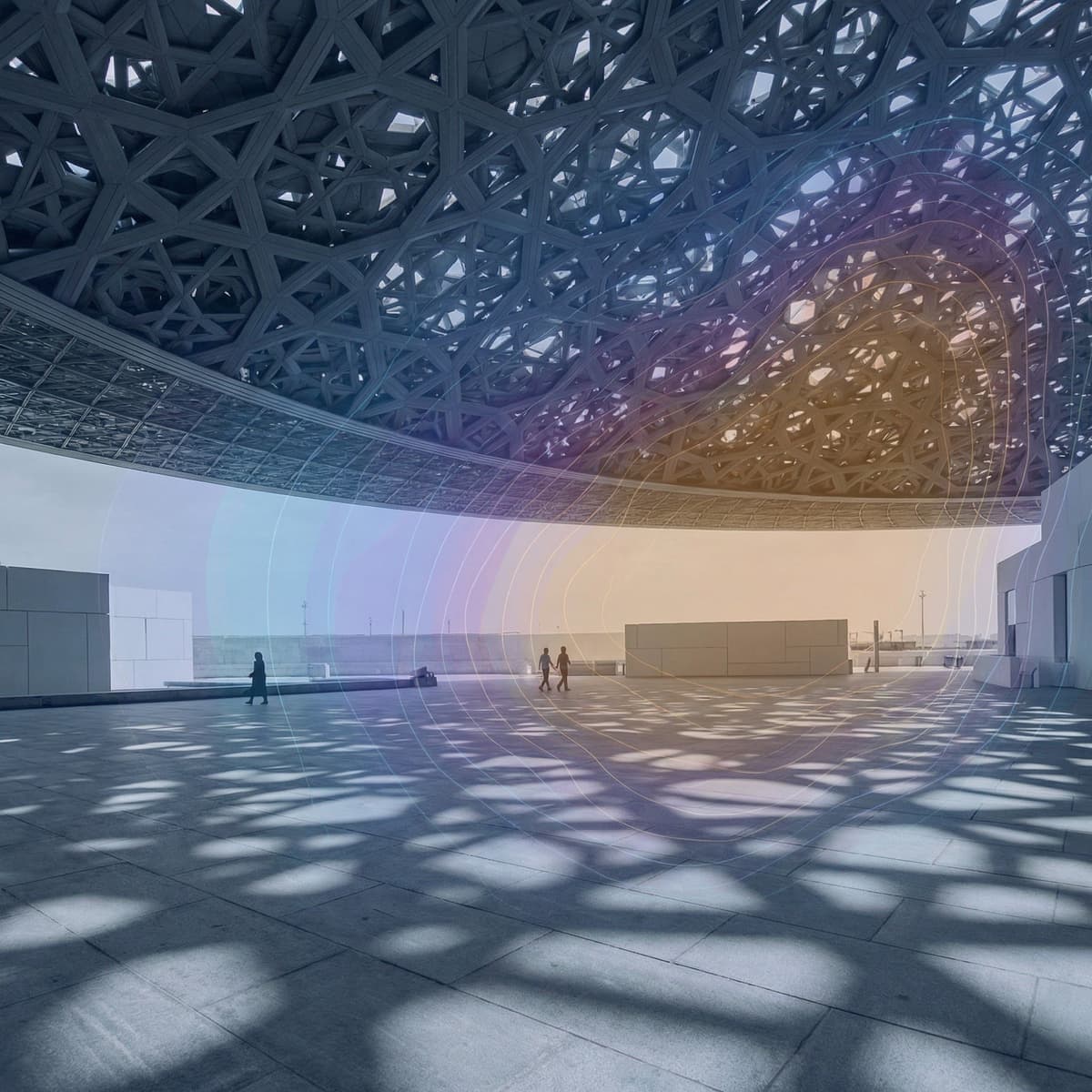
Civic space rarely announces itself as climate work. Yet every plaza, walkway, or forecourt is a negotiation with heat, light, and air. I am interested in how architectural form can act as quiet infrastructure, not by overpowering climate but by translating it into readable gradients that people can inhabit.
In humid contexts, comfort is temporal and mobile. People move through bands of shade, pause in cooler pockets, and recalibrate with breeze. A single, uniform shade layer can flatten these behaviours. A gradient, by contrast, leaves room for choice and allows space to stay civic.
Research Question
The inquiry is simple. How can computational design produce a spatial field of thermal and luminous gradients that are legible, adaptive, and civic in character. The work must remain measurable, yet avoid locking space into a single script of use.
Method: Data to Geometry
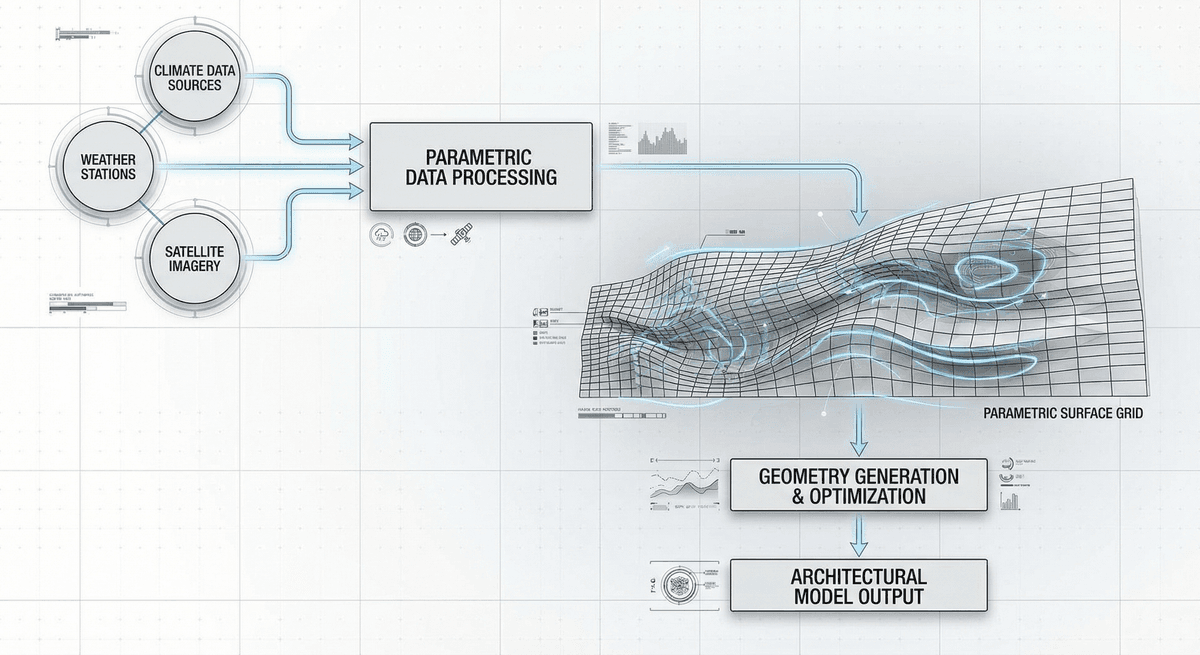
The process begins with climate data, solar altitude, prevailing wind, mean radiant temperature, and surface albedo. These are translated into targets. For example, zones where MRT should drop by a few degrees, and zones where airflow should be moderated but not blocked.
These targets shape geometry. A canopy becomes a calibrated surface with variable thickness and porosity. Ground materials shift reflectance and conductivity to reinforce the gradient. The result is computationally derived yet materially grounded.
Material Logic and Fabrication
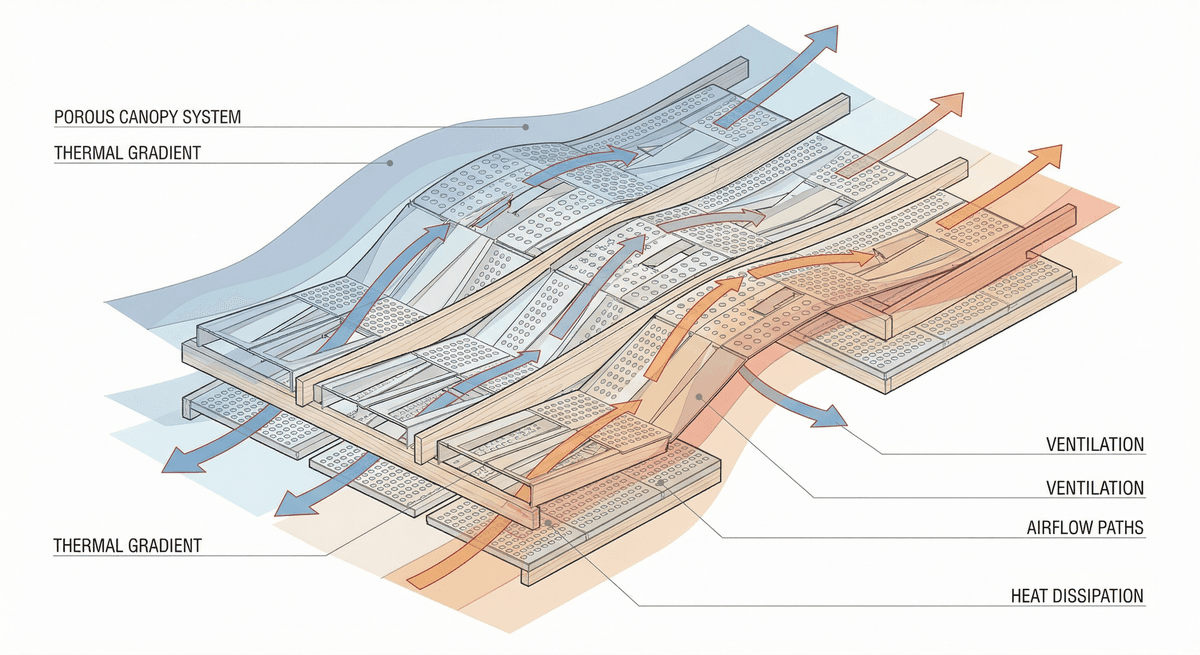
Early prototypes show that microclimate design depends on thickness as much as form. I use layered assemblies: a porous skin to filter light, a structural core for stiffness, and a lower layer to soften glare. This creates a canopy with distinct micro behaviours across its span.
The ground plane is treated as a climate instrument. High albedo aggregates reduce surface temperature, while conductive inlays stabilise thermal shifts. Materials are not decoration here. They are part of the performance system.
Simulation as Feedback
The workflow is iterative. Simulations map heat loads to surface geometry and reveal where shade density is too high or airflow stagnates. The parametric model becomes a negotiation engine rather than a form generator.
Spatial Outcomes
The result is a civic field with transition bands, rest nodes, and exchange zones. These are not labelled, they are felt. Behaviour follows microclimate cues rather than signage, which keeps the space open and civic.
Reflections
This work sits between architectural design and computational research. The tools are part of the inquiry, and the goal is to make climate a legible medium rather than a background constraint. A subtle gradient can distribute comfort more equitably than a single shaded object.
Looking Ahead
Next steps include full scale prototyping and field measurement. Simulations are necessary, but real behaviour and material ageing provide the truth. I am also exploring adaptive layers that respond to seasonal shifts without becoming high maintenance.