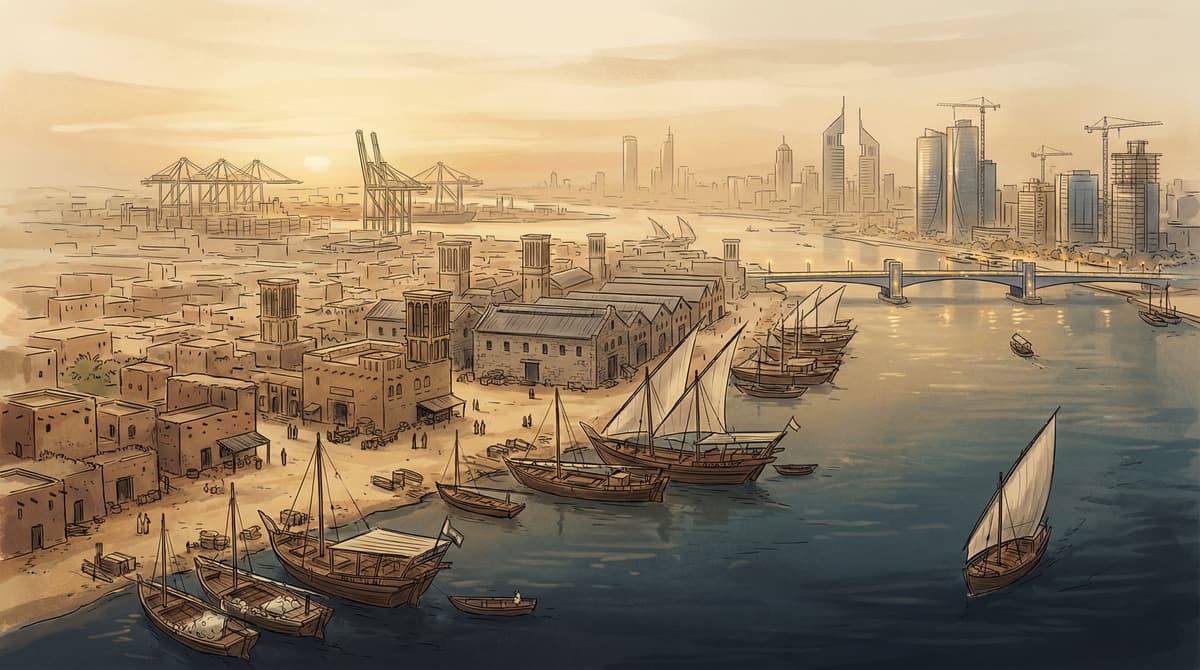
The chapter traces Dubai’s improbable rise from a marginal Gulf pearling settlement to a hyper–globalized trade hub. Its starting point is a deep, long‑distance maritime economy: a 7,000‑year history of pearl diving and trade that formed the region’s economic base long before oil.
Pax Britannica and the Merchant City
British treaties in the 19th century imposed a “Pax Britannica,” stabilizing sea lanes while freezing political development. Dubai’s rulers—Al Maktoum from 1833—leaned into neutrality and commercial openness between stronger neighbours. The pivotal move came under Sheikh Maktoum bin Hasher: abolishing customs, granting tax exemptions, and tolerating smuggling, effectively creating a proto–free port that drew merchants from Iran, India, and across the Gulf.
The city became the coast’s key entrepôt. The pearling economy peaked around 1912, then collapsed under the Great Depression, Japanese cultured pearls, and Indian taxation. What followed was debt, hunger, and political unrest, including a reformist majlis (1938–39) demanding revenue sharing and public spending—violently crushed by Sheikh Said.
Rentier Experiments Before Oil
From the late 1930s Dubai experimented with rentier logic even before significant oil discovery: air rights and concessions, backed by British gunboat diplomacy and domestic repression through World War II’s “time of hunger.” The ruling family held power by combining imperial protection with mercantile flexibility.
“Build It and They Will Come”
The true pivot arrives under Sheikh Rashid (from 1958), who bets on infrastructure at a scale far beyond immediate demand. Against British advice, he dredges and widens the silting Creek, builds a jet airport (later launching Emirates), and constructs Port Rashid and Jebel Ali. These were debt‑financed gambles rooted in a singular mentality: build the future, then force the market to arrive.
Oil as Seed Capital
Oil arrives late (1966) and in modest quantities, which paradoxically becomes an advantage. Rather than an endpoint, oil is treated as seed capital to accelerate diversification into ports, logistics, aviation, aluminium, finance, tourism, and real estate under the banner of “Dubai Inc.” Rapid urbanization between 1960–1980 multiplies population and footprint, while free‑zone, low‑tax, low‑regulation policies attract foreign capital and labour.
The Contradictions of the Model
The text doesn’t romanticize the outcome. Dubai becomes an “Arab‑global” success story and soft‑power hub, but at the cost of authoritarian politics, extreme inequality, environmental fragility, and the erasure of older urban fabric. Nationals are roughly 10% of the population, and the city’s spectacular growth depends on migrant labor under harsh conditions.
Crux of the Reading
Dubai’s transformation is not a simple oil story. It is a deliberate political‑economic project in which a mercantile ruling family uses state power, mega‑infrastructure, and radical openness to capital to manufacture a global city out of almost nothing. The “build it and they will come” mantra is both the engine of success and the source of its contradictions: speculative, debt‑driven urbanism generates wealth and visibility while depending on authoritarian control, migrant precarity, and a fragile, resource‑intensive urban model in a hostile environment.